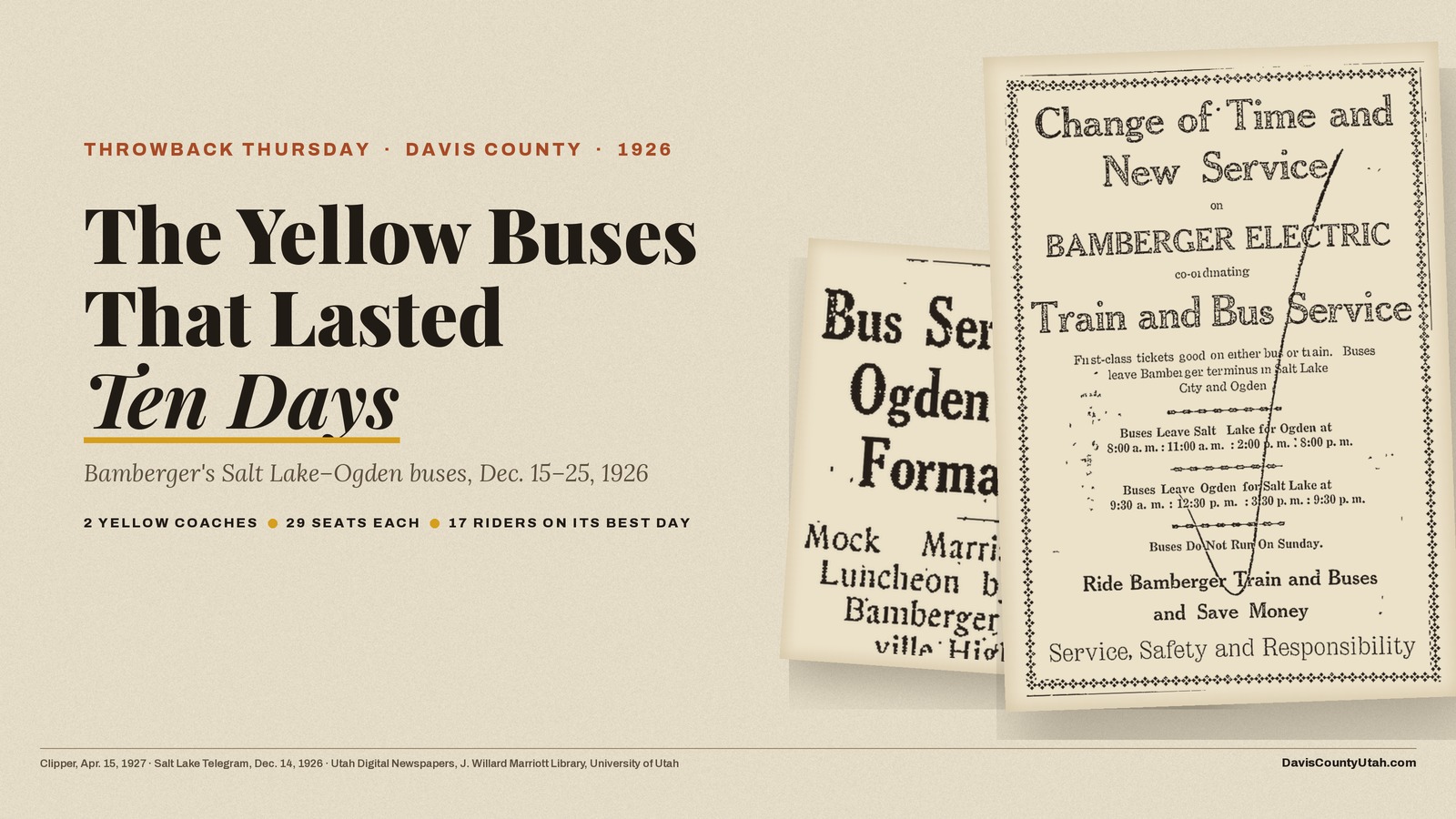
Throwback Thursday: The Yellow Buses That Lasted Ten Days (Davis County, 1926)
One hundred years ago this week, the Davis County Clipper ran a short item on its front page. The Bamberger Electric railroad expected to start bus service between Salt Lake and Ogden by December 1, 1926. Its general superintendent, N. S. Wiltsie, had just come home from the East, where he had looked over the new buses in Chicago. They would be delivered, he said, in about two weeks.
It sounded simple. It turned out to be one of the shortest-lived bus lines Davis County ever saw.
A railroad that wanted the road, too
By 1926 the Bamberger interurban had been carrying people up and down the county for years. It was the same company that built Lagoon to sell train tickets. (We told that story in Did You Know Lagoon Was Built to Sell Train Tickets.) But the highway was getting busier. The Clipper noted that another firm, the Salt Lake and Ogden Transportation Company, was already hauling freight by truck over the same route.
That January, the Clipper reported that Bamberger had asked the state Public Utilities Commission for permission to run an automobile passenger line between Salt Lake and Ogden. The same hearing drew in the Utah Light & Traction Company, which wanted to give up its streetcar line to Bountiful and Centerville. That fight ended with the streetcar track coming up, as we wrote last week in The Week They Took Up Centerville’s Streetcar Track.
In August the commission said yes. According to the Clipper, Bamberger planned buses every two hours, five trips a day, and the commission made clear it expected a real, modern bus line, not just a sideline to the trains. The buses would carry passengers only. No freight.
Two “De Luxe” yellow coaches
On October 1 the Clipper announced the purchase: two De Luxe Yellow Coaches built by General Motors in Chicago, each seating 29 passengers in individual upholstered seats, with air brakes and what the paper called the most up-to-date appliances of any bus in the country. The plan was to start running them by the middle of October.
October came and went. So did December 1. On November 26 the Salt Lake Telegram reported that the buses were finally being shipped, and that the first one would leave Salt Lake at 7:45 in the morning, about December 15.
Lunch in Kaysville
The line opened with a party. On December 14, 1926, one bus left Salt Lake and another left the Bamberger station in Ogden at the same time, each full of invited guests. They met in the middle, at Kaysville. Both the Telegram and the Ogden Standard-Examiner reported a luncheon at the Davis County high school there, hosted by railroad president Julian M. Bamberger. Governor George H. Dern spoke. Ogden’s mayor, George E. Browning, was on the program. The Telegram says the entertainment even included a mock wedding, with an Ogden “bride” and a Salt Lake “groom,” a joke about the two cities being joined by the new line.
Regular service started the next day, Wednesday, December 15.
Seventeen riders on its best day
Then reality arrived, right along with winter. A week later the Telegram printed the numbers Julian Bamberger gave out: the most passengers the buses had carried in a single day was seventeen, and the best day’s fares came to $30. The headline put the daily cost of running the line at about $100.
On December 22 the Public Utilities Commission let the company stop regular bus service, effective Christmas Day. The reason given, according to the Telegram, was simple: the public wasn’t using the service at that time of year. The shiny yellow coaches had run for about ten days.
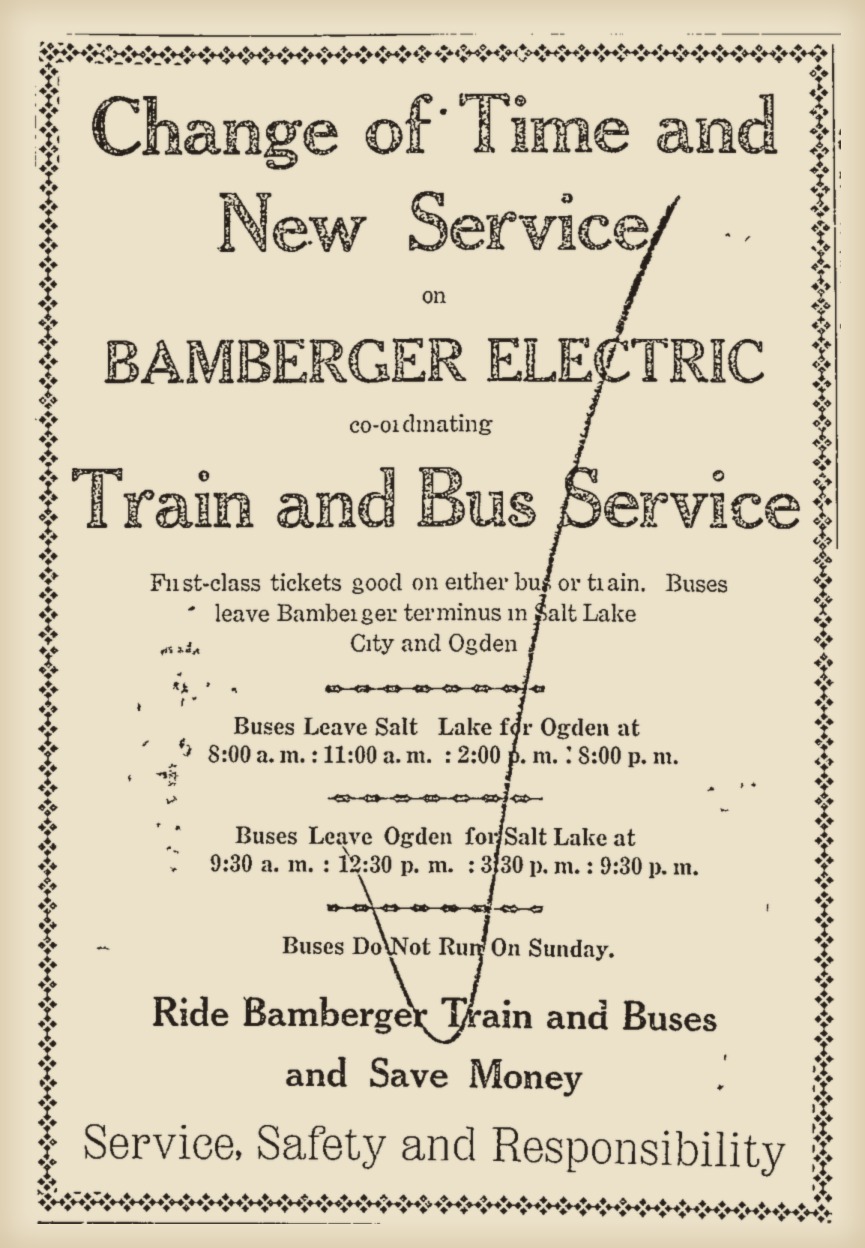
That wasn’t quite the end. On April 15, 1927, the Clipper reported that Bamberger would resume its Salt Lake–Ogden bus service the following Monday, after shutting it down for the winter. By spring, the railroad’s ads in the Clipper were listing train and bus times side by side.
It’s a small story, but a telling one. In a single year, Davis County watched one company pull up its streetcar track and another try to put buses on the highway next to its own trains. The way people moved between Salt Lake and Ogden was changing fast, and even the railroad was hedging its bets.
Did anyone in your family ride the Bamberger, by train or by bus? Tell us what they remembered. You can find more stories like this one in our Davis County history hub and on the Kaysville history page.
Sources
- Davis County Clipper (Bountiful, Utah), November 12, 1926, p. 1. Utah Digital Newspapers, J. Willard Marriott Library, University of Utah.
- Davis County Clipper (Bountiful, Utah), January 29, 1926, p. 1. Utah Digital Newspapers, J. Willard Marriott Library, University of Utah.
- Davis County Clipper (Bountiful, Utah), August 20, 1926, p. 1. Utah Digital Newspapers, J. Willard Marriott Library, University of Utah.
- Davis County Clipper (Bountiful, Utah), October 1, 1926, p. 1. Utah Digital Newspapers, J. Willard Marriott Library, University of Utah.
- Salt Lake Telegram (Salt Lake City, Utah), November 26, 1926, p. 17. Utah Digital Newspapers, J. Willard Marriott Library, University of Utah.
- Salt Lake Telegram (Salt Lake City, Utah), December 14, 1926, p. 2. Utah Digital Newspapers, J. Willard Marriott Library, University of Utah.
- Ogden Standard-Examiner (Ogden, Utah), December 14, 1926, p. 10. Utah Digital Newspapers, J. Willard Marriott Library, University of Utah.
- Salt Lake Telegram (Salt Lake City, Utah), December 22, 1926, p. 9. Utah Digital Newspapers, J. Willard Marriott Library, University of Utah.
- Salt Lake Telegram (Salt Lake City, Utah), December 23, 1926, p. 2. Utah Digital Newspapers, J. Willard Marriott Library, University of Utah.
- Ogden Standard-Examiner (Ogden, Utah), December 23, 1926, p. 3. Utah Digital Newspapers, J. Willard Marriott Library, University of Utah.
- Davis County Clipper (Bountiful, Utah), April 15, 1927, p. 1. Utah Digital Newspapers, J. Willard Marriott Library, University of Utah.
- Davis County Clipper (Bountiful, Utah), April 15, 1927, p. 4 (Bamberger train and bus advertisement). Utah Digital Newspapers, J. Willard Marriott Library, University of Utah.